Join a webinar and gain knowledge from an experts on eating disorders.
Cognitive Rigidity in Eating Disorders: How Psychedelics May Help
About this Webinar:
This webinar will describe what is known about cognitive rigidity, or how patients with eating disorders get stuck in thinking patterns that cause suffering and can give rise to unhealthy patterns of eating and exercise. We will then discuss how new treatments such as psilocybin and ketamine might help patients shift out of these rigid thought and behavior patterns. We will share information about what is known about these treatments and what trials are ongoing.
Presenter Bio
Marissa Raymond-Flesch, MD, MPH, is a Professor in the University of California San Francisco (UCSF) Division of Adolescent and Young Adult Medicine and its interdisciplinary Eating Disorder Program. Clinically, she practices Adolescent and Young Adult Medicine with patients 12 to 26 years old, including primary care and the treatment of eating disorders, depression, and anxiety. Her research includes investigating novel therapeutics for the treatment of eating disorders and equitable access to medical care for marginalized populations. She is the Principal Investigator for the Study of Psilocybin for Anorexia Nervosa in Young Adults (SPANYA), an ongoing clinical trial.
Amanda Downey, MD is a pediatrician and child and adolescent psychiatrist who cares for adolescents and young adults with eating disorders. She works with patients and their families to develop a treatment plan that honors their unique strengths and challenges. Through education, advocacy and research, she strives to dismantle the systems that increase risk for eating disorders and improve evidence-based eating disorder treatments. She is the assistant medical director of the UCSF Eating Disorders Program, Principal Investigator in the Ketamine Effects on Learning In Eating Disorders trial and a co-investigator in the Study of Psilocybin for Anorexia Nervosa in Young Adults.
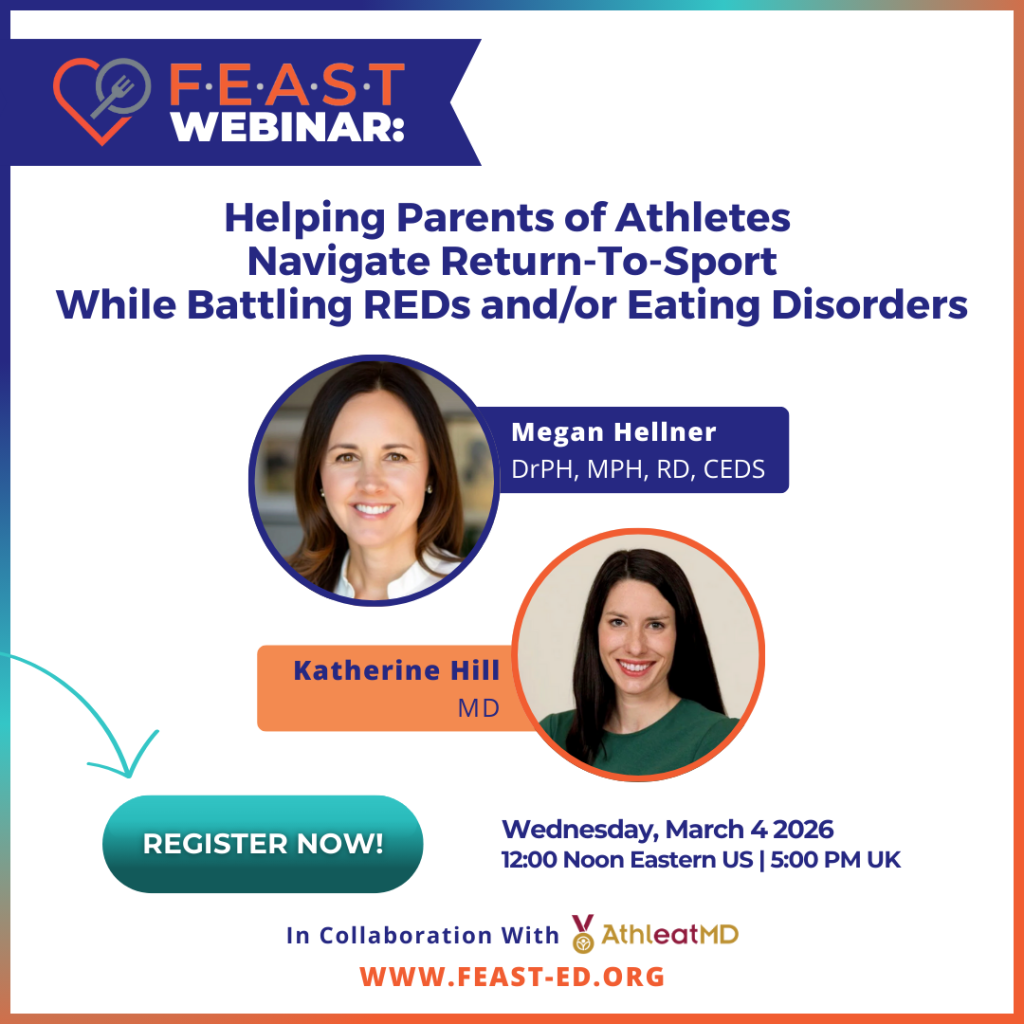
Helping Parents of Athletes Navigate Return-To-Sport While Battling REDs and/or Eating Disorders
About this Webinar:
When a young athlete is experiencing Relative Energy Deficiency in Sport (REDs) or an eating disorder, parents often face the difficult challenge of balancing activity restrictions with the desire to allow full sport participation. This session will help parents understand this “gray area” and provide practical, research-backed guidance for supporting a safe return to sport.
We’ll begin with an overview of REDs—what it is, how it overlaps with eating disorders, and how it differs. From there, we’ll review the medical and nutritional markers used to determine when sport participation is safe. Parents will learn practical tips on how to support a gradual, safe return without relying on unnecessary or outdated “all-or-nothing” approaches. By the end of this session, parents will feel more confident in guiding their athlete through recovery, reducing anxiety, preventing setbacks, and promoting a sustainable return to sport that prioritizes health and recovery above performance.
Presenter Bio
Katherine Hill, MD is a board-certified pediatrician and eating disorder specialist with over 15 years experience in the field, first getting interested in athletes and disordered eating as an NCAA Division I swimmer. She completed medical school and pediatric residency at Stanford, and spent 4 years as faculty at Stanford as Clinical Assistant Professor of Adolescent Medicine. She then served as the lead medical doctor and Vice President of Medical Affairs and Care Delivery at Equip Health for nearly 5 years before joining forces with Dr. Megan Hellner to found AthleatMD, a medical and nutrition practice focused on athletes struggling with sports nutrition, REDs, and eating disorders.
Dr. Megan Hellner is a California-based researcher and registered dietitian with 20(ish) years of experience treating athletes with eating disorders. Throughout her career, she’s partnered with numerous sport organizations nationwide as both a clinician and educator, and served as a founding dietitian for several eating disorder treatment programs. Dr. Hellner is a Cofounder of AthleatMD, a virtual multi-state practice providing medical and nutrition support to athletes with disordered eating and/or REDs. She is deeply passionate about helping athletes across sport and skill-level navigate food and body issues through the various stages of their athletic career, such as competition, off-season, pregnancy/postpartum, or ‘retirement’ from sport.